Queensland (QLD)
North of Rockhampton, cyclone is priced on its own line.
Queensland is two insurance markets in one state. South East Queensland is a flood and hail market. North of the Tropic of Capricorn is a cyclone and storm tide market, and we show those as separate components on the quote rather than folding them into one number.
What is different about insuring in Queensland
The Tropic of Capricorn runs through Rockhampton, and it is the most consequential line on any Australian insurance map. South of it, the dominant perils are riverine flood, flash flood and hail. North of it, cyclone and storm tide take over, and the pricing structure changes with them.
Queensland is also where the Australian Government intervened directly in the market. The Cyclone Reinsurance Pool, administered by the Australian Reinsurance Pool Corporation, was established in 2022 specifically to bring down cyclone premiums in northern Australia. Insurers writing eligible home, strata and small business risks in the cyclone zone cede that risk to the pool. It is why northern Queensland premiums have moved the way they have since 2023.
The third Queensland factor is flood, and it is not the same flood in every catchment. The Brisbane River in 2011 and again in 2022, the Fitzroy at Rockhampton, the Mary at Gympie and the Barron north of Cairns are four genuinely different hydrological problems, and rating them with a single postcode loading would be wrong. We rate to the address.
What you pay on top of the premium
- Insurance levy
- NoneThe Emergency Management Levy is collected on council rates, not on premiums
- Stamp duty
- 9%On general insurance, applied to the premium plus GST
- GST
- 10%Applied to the base premium
- CTP with rego
- You choosePaid with registration, but you nominate a licensed CTP insurer
The risks we rate for in QLD
Cyclone
North of the Tropic of Capricorn, rated separately and ceded to the Cyclone Reinsurance Pool where eligible. Roof, ceiling and water ingress are the recurring damage pattern.
Storm tide
Cyclone driven sea level rise on top of a high tide. Distinct from flood and distinct from actions of the sea, and rated by elevation above the storm tide level.
Riverine flood
The Brisbane, Bremer, Fitzroy, Mary and Barron systems. Included as standard, rated by floor level relative to the defined flood level at the address.
Hail and storm
South East Queensland produces severe hail most summers. The 2020 Rocklea and 2014 Brisbane events each ran to hundreds of millions in claims.
You pay CTP with your rego, but you still pick who gets it.
Queensland sits between the two extremes. The CTP premium is collected with your registration by the Department of Transport and Main Roads, so there is no separate purchase to remember. But you nominate which licensed CTP insurer receives it, and that nomination carries through to who manages a claim.
Premiums are regulated within a band set by the Motor Accident Insurance Commission, so the differences between insurers are much smaller than the differences between Green Slip providers in New South Wales. The choice matters more for claims handling than for price.
As everywhere, CTP covers injury to people and nothing else. No car, no fence, no shopfront. If you write off a vehicle at an intersection in Brisbane, CTP will not contribute a dollar towards it.
Where our QLD customers are
| Region | Postcodes | What drives the rating |
|---|---|---|
| Brisbane inner and west | 4000 to 4075 | Brisbane and Bremer river flood, rated on floor level. High rebuild cost on pre-1946 Queenslanders under character protection. |
| Gold Coast | 4207 to 4228 | Storm, hail, and canal frontage exposure. High contents values and a large strata component. |
| Sunshine Coast and Gympie | 4550 to 4570 | Mary River flood at Gympie, plus severe storm and coastal exposure through the Sunshine Coast strip. |
| Rockhampton and Capricornia | 4700 to 4740 | On the Tropic. Fitzroy River flood, and the point at which cyclone rating begins to apply. |
| Townsville and the north | 4810 to 4825 | Cyclone and storm tide, plus the 2019 monsoon flood which remains the largest single Queensland flood event by claim count. |
| Cairns and the Far North | 4870 to 4895 | Cyclone, monsoon flood on the Barron, and storm tide along the coastal strip. Eligible risks are ceded to the Cyclone Reinsurance Pool. |
A QLD claim, settled
Water through the shop after the January flood. They paid an interim amount for stock while the business interruption side was still being worked out, so I could reopen.
QLD questions
What is the Cyclone Reinsurance Pool and does it help me?
It is a government backed reinsurance pool administered by the Australian Reinsurance Pool Corporation, established in 2022 to reduce cyclone premiums in northern Australia. Insurers writing eligible home, residential strata and small business risks in the cyclone zone cede that cyclone risk to the pool at a regulated price. If you are north of the Tropic of Capricorn and your premium fell between 2023 and 2025, this is usually why.
Is storm tide the same as flood?
No, and the distinction matters. Storm tide is a rise in sea level driven by a cyclone or severe storm, pushing seawater inland on top of a high tide. Flood is fresh water escaping from a watercourse. Actions of the sea, which is ordinary wave action and erosion, is different again and is excluded. Our home policy covers storm tide and flood, and excludes actions of the sea, and your certificate of insurance says so in those words.
My house is a pre-1946 Queenslander. Does that change anything?
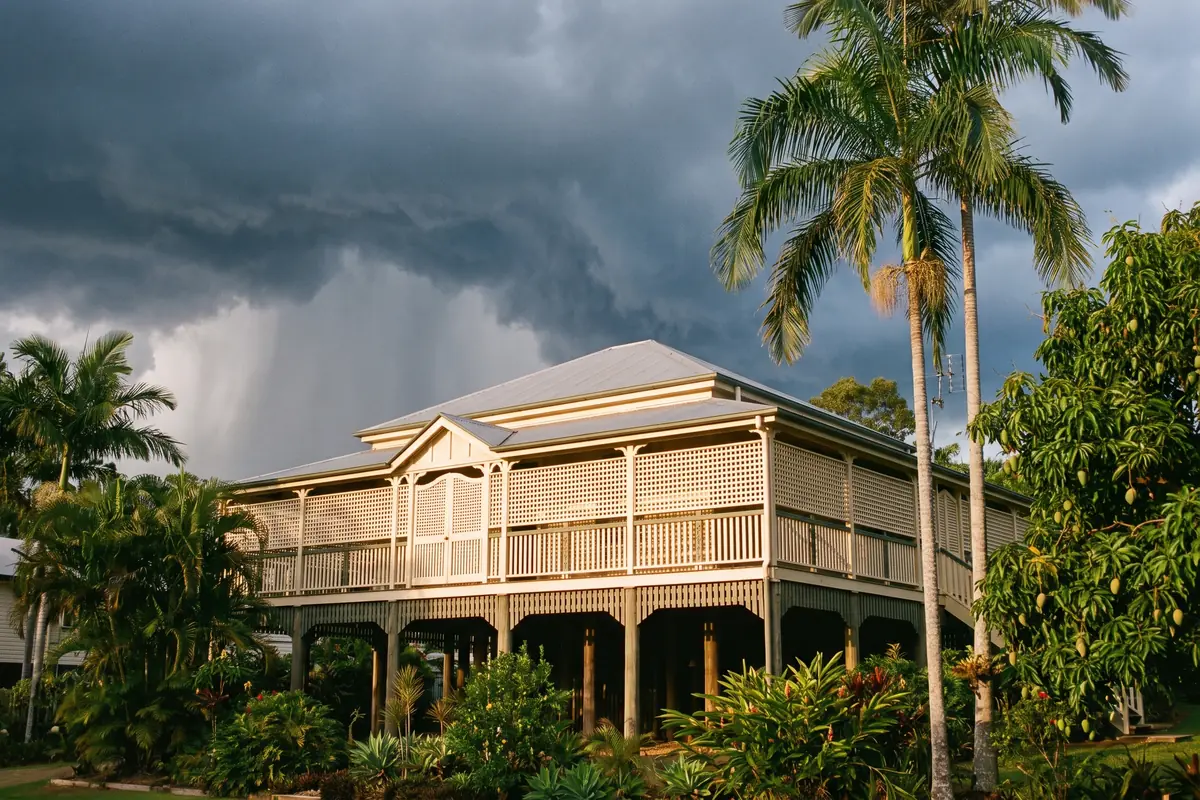
Yes, in two ways. Character protection in many Brisbane suburbs means a rebuild must match the original construction, which raises the cost per square metre substantially. And a raised timber house on stumps has a very different flood profile from a slab house, because the floor level relative to the defined flood level is what we rate. Both of those work in your favour on flood and against you on rebuild cost, so tell us the construction accurately.
Do you rate my flood risk on my postcode?
No. Queensland flood is rated to the address, using floor level relative to the defined flood level for that catchment. Two houses on the same street can be genuinely different risks if one is a metre higher. If you have a flood certificate or a survey from your council showing your floor level, send it, because it usually helps.
What happens after a cyclone crosses the coast near me?
The Insurance Council of Australia normally declares an insurance catastrophe within a day. Once that is in place we work the affected postcodes rather than waiting for calls, make safe proceeds without any approval step or quotes, assessment is ordered by vulnerability and severity, and no policy in an affected postcode is cancelled for non-payment for twelve months. In the wet season, access is usually the constraint rather than assessor capacity.
This advice is general only and does not take into account your objectives, financial situation or needs. Before acting on it, consider whether it is appropriate for you. Consider the PDS and TMD before deciding whether a product is right for you.
Get a Queensland quote in two minutes.
Eight questions and you will see the premium, the excess and the main exclusions on one screen. All premiums shown are in Australian dollars and include GST and stamp duty, plus the NSW Emergency Services Levy or the Tasmanian Fire Service Contribution where they apply.
Consider the PDS and TMD before deciding. Premiums include GST and stamp duty.